Wind is a low-emission energy source
The JRC reports average life-cycle emissions of approximately 7.4 g CO₂e/kWh for onshore wind and 17 g CO₂e/kWh for offshore wind.
Separate topic · Evidence-based
Wind power is a low-carbon energy source. That does not exempt large offshore installations from documenting their local and cumulative impacts – particularly near Wadden Sea National Park and the UNESCO World Heritage Site.
What we state as fact must be supported by evidence. What we do not yet know must be investigated.
The EU's Joint Research Centre assesses wind power as an energy source with low life-cycle greenhouse-gas emissions. At the same time, research and government reports document impacts from construction noise, foundations, cables, corrosion protection, blade wear, vessel traffic and the displacement of existing activities.
The impacts are not identical for every project. They must therefore be assessed for the specific area and cumulatively – not only turbine by turbine or project by project.
The JRC reports average life-cycle emissions of approximately 7.4 g CO₂e/kWh for onshore wind and 17 g CO₂e/kWh for offshore wind.
Research has recorded underwater noise, displacement of wildlife, physical changes to habitats and emissions of materials.
Several official studies point to gaps in knowledge about chronic and cumulative effects on populations and ecosystems.
10–12
million
UNESCO states that up to 6.1 million birds may be present in the Wadden Sea at the same time and that 10–12 million migrate through the area each year. UNESCO lists wind farms among the activities that may affect the World Heritage values.
Under the common Wadden Sea policy, wind farms are not permitted within the World Heritage property itself. Installations outside it can only be accepted if the area's ecological and landscape values are not harmed. Cable crossings must be minimised and bundled, and impacts on birds and marine mammals must be limited.
UNESCO requires direct, indirect and cumulative effects to be included when assessing projects that may affect World Heritage.
UNESCO: Wadden Sea
UNESCO: Wind-energy policy around the Wadden Sea
UNESCO: Assessing impacts from renewable energy
Research and authorities
Here we distinguish between recorded impacts and questions that still lack long-term or site-specific answers.
Blades
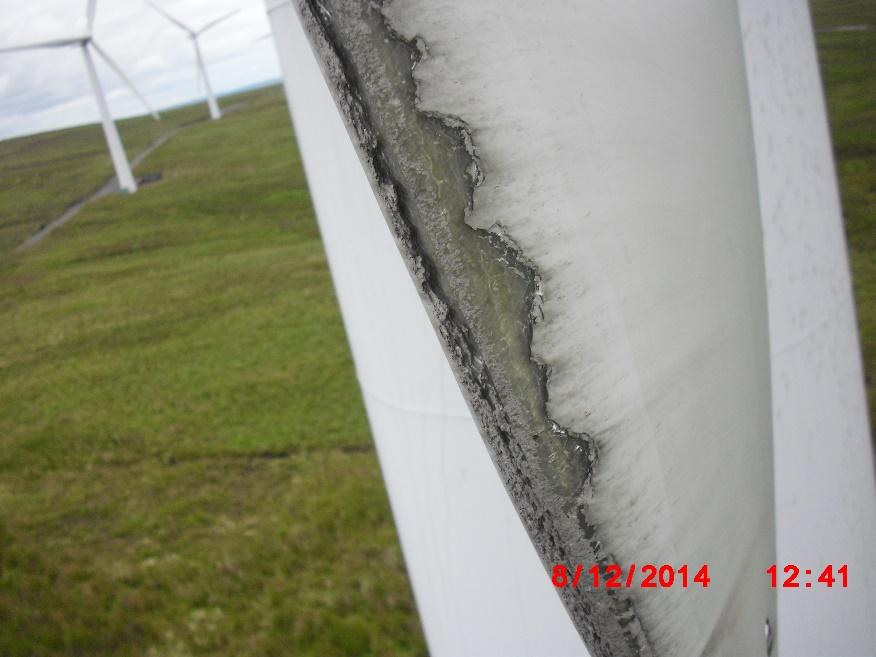
A peer-reviewed DTU study estimates approximately 30–540 grams of eroded plastic per blade per year across its overall range, and approximately 80–1,000 grams offshore. For Denmark's wind-turbine fleet, the study estimates approximately 1.6 tonnes per year under the assumptions of the model.
DTU, 2024: Erosion and Microplastic Emission from Wind Turbine Blades (PDF)
Foundations
Germany's Federal Environment Agency identifies potential emissions from corrosion protection, cooling and antifouling systems, coatings, operating fluids and accidents. One technical example in the report calculates approximately 38 kg of aluminium per foundation per year from a particular type of coating; the figure does not automatically apply to every wind farm.
Umweltbundesamt, 2024: Hazardous substances from offshore wind
Marine mammals
At Horns Rev II, harbour-porpoise acoustic activity was reduced very close to the construction site following pile driving. The study detected a negative response out to an average distance of 17.8 kilometres. It documents a temporary local impact, not in itself a lasting decline in the population as a whole.
Birds
The Wadden Sea Quality Status Report describes divers as particularly sensitive to offshore wind and reports avoidance at distances exceeding ten kilometres. It also identifies collision risk, attraction to light and disturbance from maintenance vessels. Responses vary between species.
Ocean physics
Measurements at two German wind farms indicated increased vertical mixing, altered stratification and nutrient transport. The researchers also stress that natural variability makes the precise impact difficult to isolate.
Floeter et al., 2017: Pelagic effects in the stratified North Sea
Subsea cables
A 2026 systematic review found behavioural or physiological responses in 66% of the 67 studies included, frequently in fish and crustaceans. The authors also highlight major knowledge gaps concerning chronic effects on populations and ecosystems.
James, Ghodsi & Ford, 2026: 35-year synthesis of submarine cable EMF
Fisheries
ICES and UK government reports describe how offshore energy can displace fishing into other areas, increase steaming distances and costs, and intensify competition for the remaining fishing grounds. The consequences depend on the fleet, fishing gear, area and opportunities for coexistence.
ICES, 2025: Offshore renewable energy and fisheries (PDF)
Marine Scotland: Fisheries displacement
The North Sea
An integrated analysis of the North Sea shows the need to assess the seabed, fish, birds and marine mammals across projects. Deltares likewise concludes that large-scale development may affect currents, stratification, sediment and biological production.
Scientific Reports, 2021: Cumulative effects in the North Sea
Deltares: System effects of large-scale offshore wind
Questions for DN
DN requires a small local brown-shrimp fishery to document its impact on the Wadden Sea. That is a legitimate requirement.
But will DN impose the same requirement for concrete, site-specific and independent evidence on the far greater industrialisation of the North Sea?
Burden of proof
What materials, surface treatments and operating fluids are used in blades, foundations, cables and platforms?
What material losses and chemical emissions are expected under local marine and weather conditions over the installations' service life?
How are particles, metals and other substances measured in water and sediment before, during and after construction?
How are bird migration, harbour porpoises, fish, crustaceans, the seabed, currents and sediment affected?
How is the cumulative impact of all existing and planned wind farms, cables, vessels and closed sea areas calculated?
If the precautionary principle is to be applied to four small fishing vessels, why should it not be applied at least as consistently to large industrial installations?
Open sources
Every principal factual statement on this page can be traced to research, government reports or UNESCO. The sources describe recorded impacts as well as limitations and contrary findings.
World Heritage
World Heritage values, bird numbers, integrity and known impacts.
World Heritage
Siting, cable crossings and protection of the area's values.
Blade wear
Model estimates, ranges and assessment of earlier high claims.
Laboratory research
PhD thesis on erosion; not a field measurement of Danish wind turbines.
Chemical emissions
Potential sources during installation, operation and decommissioning.
Regulation
Comparison of requirements and evidence gaps in North Sea countries.
Harbour porpoises
Danish field study of responses during construction.
Marine ecosystem
Field indications of altered mixing and nutrient transport.
Cables
Systematic review of experiments and field studies on aquatic animals.
Cumulative effects
Cross-project analysis of the seabed, fish, birds and marine mammals.
Fisheries
Ecological, economic and social consequences and research needs.
DN's own position
DN itself raises questions about hard substrate and non-native species, among other issues.
The other main issue
The mine-related prohibition, DN, the lawyers' letter, the fishers, the evidence and the complete timeline are gathered on the fishing-case page.
Go to the fishing case →